
Contact Houston Dental Implants & Prosthodontics | Memorial City
- 713-464-6335
-
Memorial Hermann Memorial City
Medical Plaza 3
915 Gessner Road, STE. 515
Houston, Texas 77024 - markstankewitz515@gmail.com
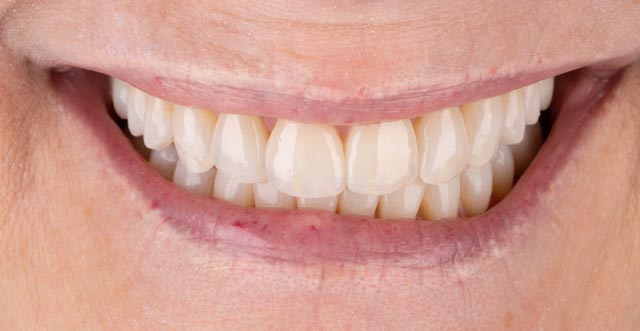
Porcelain veneers in Houston can improve the shape, proportion, color, and overall appearance of teeth while preserving a natural-looking smile. At Houston Dental Implants & Prosthodontics, Dr. Mark Stankewitz designs each case around the patient’s facial features, tooth proportions, bite, and esthetic goals.
As a board-certified prosthodontist with decades of experience in restorative dentistry and dental ceramics, Dr. Stankewitz approaches veneers as both an esthetic and functional restoration—not simply a cosmetic covering for the teeth.
Porcelain veneers are thin, custom-made ceramic restorations bonded to the front surfaces of teeth. They can be used to improve several aspects of a smile while maintaining a natural appearance.
Porcelain veneers may be appropriate for correcting:
The important difference is that veneers should not be planned one tooth at a time. Dr. Stankewitz evaluates how the teeth relate to the lips, face, gums, and bite so the final result looks natural and functions appropriately.
When carefully planned and properly maintained, porcelain veneers can provide several advantages:
The long-term success of porcelain veneers depends not only on the ceramic material, but also on careful diagnosis, treatment planning, conservative tooth preparation, bite management, and the quality of the final restorations.
Creating natural-looking porcelain veneers involves more than choosing a tooth shape and shade. Tooth proportions, translucency, surface texture, gum contours, lip position, facial features, and the patient’s bite all influence the final result.
Dr. Mark Stankewitz is a board-certified prosthodontist with decades of experience in restorative dentistry and dental ceramics. His training and laboratory experience allow him to evaluate both the esthetic details of individual teeth and how the restorations function as part of the entire smile and bite.
Each veneer case is individually planned to complement the patient’s facial features and existing teeth rather than creating a standardized or artificial-looking smile. The goal is a result that looks natural, functions appropriately, and is designed specifically for the individual patient.
1. Consultation and Evaluation
Dr. Stankewitz evaluates your teeth, gums, bite, facial proportions, and existing dental restorations while discussing what you would like to change about your smile. This helps determine whether porcelain veneers are the most appropriate treatment or whether another option would provide a better result.
2. Smile Design and Treatment Planning
The size, shape, length, proportion, and position of the proposed veneers are planned in relation to your smile and facial features. This allows the desired result to guide treatment before the teeth are prepared.
3. Conservative Tooth Preparation
When preparation is necessary, the teeth are carefully shaped to provide appropriate space for the porcelain while preserving as much healthy tooth structure as the clinical situation allows.
4. Provisional Veneers
Temporary veneers protect the prepared teeth and provide an opportunity to evaluate tooth shape, length, appearance, speech, and bite before the final restorations are completed. Adjustments can be made during this stage to help refine the final design.
5. Final Porcelain Veneers
Before the veneers are bonded, Dr. Stankewitz evaluates their fit, color, shape, proportions, surface characteristics, and relationship to your bite and surrounding teeth. With an on-site dental laboratory, important esthetic details can be closely evaluated and refined before the restorations are finalized. Once these details are confirmed, the veneers are bonded to the teeth and the bite is carefully evaluated.
Porcelain veneers can be an excellent treatment for the right patient, but they are not appropriate for every cosmetic or restorative concern. Careful evaluation of the teeth, gums, existing restorations, and bite is important before treatment begins.
Veneers may be appropriate for patients who:
Porcelain veneers may not be the best treatment when teeth are significantly weakened, heavily restored, severely worn, or affected by certain bite problems. In these situations, orthodontics, crowns, bonding, or other restorative treatment may provide a more predictable result.
Dr. Stankewitz evaluates these factors before recommending treatment so that the choice of restoration is based on the condition of the teeth and the patient’s long-term needs—not simply on the desired cosmetic change.
Every veneer case is individually designed around the patient’s facial features, existing teeth, smile proportions, and esthetic goals. These cases show porcelain veneer treatment completed by Dr. Mark Stankewitz.
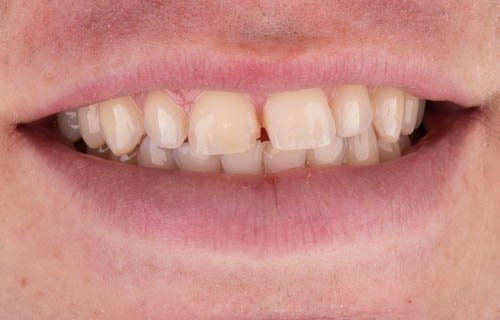
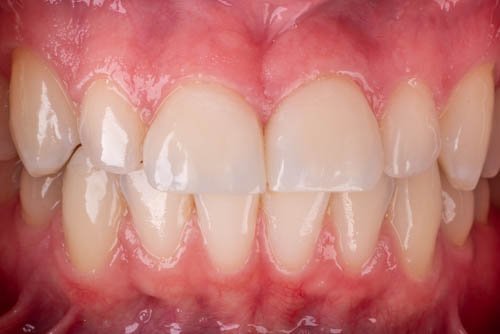
This patient had a gap between the two upper front teeth and chipping of both central incisors. Two porcelain veneers were used to close the space, restore the chipped areas, and improve tooth proportions while maintaining a natural appearance.
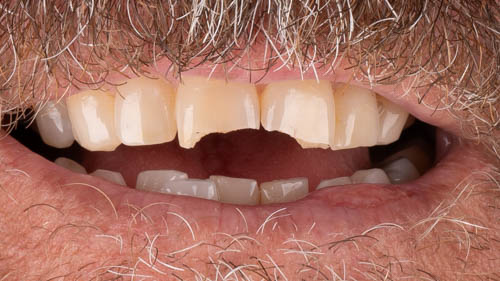
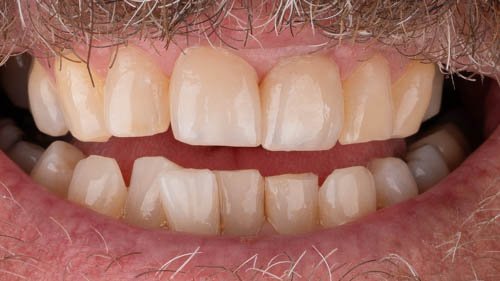
This patient experienced trauma to the front teeth after a fall. Porcelain veneers were used to restore the damaged teeth and reestablish their natural shape, proportions, and appearance while creating a result that blends with the surrounding teeth.
Porcelain veneers require a careful balance of esthetics, function, and precision. At Houston Dental Implants & Prosthodontics, veneer treatment is planned and managed by Dr. Mark Stankewitz, a board-certified prosthodontist with decades of experience in complex restorative dentistry and dental ceramics.
Board-Certified Prosthodontic Expertise
As a Diplomate of the American Board of Prosthodontics, Dr. Stankewitz evaluates veneer treatment in the context of the entire smile, bite, and long-term restorative needs of the patient.
Individualized Smile Design
Veneers are designed around each patient’s facial features, lips, existing teeth, and esthetic goals. Rather than using a standardized shape or appearance, the objective is to create proportions and characteristics that look appropriate for the individual patient.
Experience with Dental Ceramics
Dr. Stankewitz has decades of clinical and laboratory experience working with dental ceramics. This experience is particularly valuable when evaluating details such as translucency, surface texture, contours, color, and the interaction of the restorations with natural teeth.
On-Site Dental Laboratory
Our on-site dental laboratory allows Dr. Stankewitz to closely evaluate and refine important esthetic details such as tooth shape, proportions, surface texture, translucency, and color. This direct involvement provides greater control over the final appearance of porcelain restorations and helps create veneers that complement the patient’s natural teeth and facial features.
Attention to Function as Well as Esthetics
Beautiful veneers also need to function properly. The relationship between the upper and lower teeth is evaluated during treatment so the final restorations are designed with both appearance and bite in mind.
Personalized Treatment Planning
Not every patient who wants to improve a smile needs porcelain veneers. Dr. Stankewitz evaluates whether veneers, bonding, crowns, orthodontic treatment, or another restorative approach is most appropriate before recommending treatment.
Porcelain veneers are only one way to improve a smile. The most appropriate treatment depends on the condition of the teeth, the type of change desired, the bite, and how much healthy tooth structure is present.
Teeth Whitening
For healthy teeth with primarily color-related concerns, professional whitening may improve the smile without altering the tooth structure. Whitening, however, cannot change tooth shape, size, position, or proportions.
Composite Bonding
Tooth-colored composite can sometimes correct small chips, gaps, or contour irregularities with minimal tooth preparation. Porcelain veneers may offer advantages when more extensive changes in tooth shape, color, or proportions are desired.
Orthodontic Treatment
When tooth position or spacing is the primary concern, orthodontic treatment may be preferable to changing the appearance of alignment with restorations. In some cases, orthodontics can also be combined with restorative treatment.
Dental Crowns
A crown covers substantially more of the tooth than a veneer and may be more appropriate when a tooth is significantly weakened, heavily restored, fractured, or requires more extensive reconstruction.
The goal is not simply to choose the most cosmetic treatment. Dr. Stankewitz evaluates the available options and recommends an approach designed to achieve the desired esthetic improvement while preserving healthy tooth structure and supporting long-term function.
Porcelain veneers can provide many years of service when they are properly designed, bonded, and maintained. Their longevity depends on several factors, including the condition of the underlying teeth, the patient’s bite, oral hygiene, and habits such as grinding or clenching. Regular dental examinations are important for maintaining both the veneers and the surrounding teeth and gums.
Porcelain veneers generally require some degree of tooth preparation, although the amount varies depending on the tooth and the desired change. Careful treatment planning allows the preparation to be as conservative as the clinical situation permits. Because veneer treatment is generally not considered reversible once tooth structure has been removed, the decision should be made after a thorough evaluation.
Yes. Natural-looking veneers depend on much more than choosing the correct shade. Tooth proportions, translucency, surface texture, contours, the surrounding teeth, gums, lips, and facial features all influence the result. Each veneer should be designed to complement the individual patient rather than create a uniform or artificial appearance.
The cost of porcelain veneers varies according to the number of teeth being treated, the complexity of the case, the condition of the existing teeth, and the treatment required to achieve the desired result. Because each veneer case is individually planned, pricing can vary significantly from one patient to another. After evaluating your teeth, bite, and esthetic goals, Dr. Stankewitz can recommend an appropriate treatment plan and review the associated costs with you.
Sometimes, but veneers are not appropriate for every worn or heavily restored tooth. Teeth with extensive existing restorations, significant structural damage, severe wear, or certain bite problems may require crowns or another restorative approach instead. The condition of each tooth and the overall bite should be evaluated before deciding which restoration is most appropriate.
Prosthodontists receive advanced specialty training in esthetic and restorative dentistry, including the diagnosis, treatment planning, and restoration of complex dental conditions. For veneer treatment, this training is particularly relevant because the appearance of the teeth must be considered together with tooth structure, the bite, facial proportions, and long-term function.
If you are considering porcelain veneers, the first step is determining whether they are the right treatment for your teeth, bite, and esthetic goals. Dr. Mark Stankewitz will evaluate your smile, discuss what you would like to change, and explain the treatment options that may provide the most appropriate long-term result.
At Houston Dental Implants & Prosthodontics, porcelain veneer treatment is individually planned with an emphasis on natural appearance, conservative treatment, and long-term function.
Schedule a personalized consultation with Dr. Stankewitz to discuss your smile and treatment options.
Contact Houston Dental Implants & Prosthodontics | Memorial City